Wednesday, December 8, 2010

Apple's communication gap irks business buyers


Apple (AAPL, Fortune 500) decided last month Xserve line of server rack, one of his rare pure commercial products to kill. What's more, Apple's business customers is only four months to adopt, to announce that they have a "guide for the transition period" that they will not sell Xserve after 31 January 2011.

Without getting too thrilled with the finer blade servers, Xserve is essentially a high-powered Macintosh computer with more features to help you network with other computers or host sites.

Unlike a regular Mac, Xserve redundant power supplies, it can be controlled remotely, and the screws in a rack-mount shelves this area to help business customers to keep the cluster of computer network -. And that they also protect the server that contains them from harm. This is an important consideration in earthquake-prone Bay Area, where some of the Xserve customers are located.

So Apple's solution is so head-scratching: He suggested Xserve customers would rather buy a Mac Pro or Mac Mini Mac OS X Server, both can and notice that the Apple Mac Pro processor is faster than the Xserve ..

It's true - but they did not rack servers keep a Mac Mini and Xserve a side-by-side, and the comparison is ridiculous ..

Xserve customers' response was, not surprisingly, a mixture of confusion and frustration.
"It makes many, many angry," said Paul Chernoff, IT Director at Washingtonian.com, who runs a Web site two and 72 Xserve Mac support. "I do not think Apple handled it very well in terms of understanding the needs of enterprise customers."

Four months is enough knowledge of the company now has completely rethink their server infrastructure, "he said. Plus, the timing is unfortunate. Apple announced near the end of the year, right when IT departments are busy in finalizing their budgets for next year.

Apple representatives declined to comment on the Xserve, the company has canceled, and the response was to move the consumer business.

IT gurus say that the way Apple will kill the Xserve is a symptom of a larger problem: Apple has a communication gap with their corporate customers.

"Apple does not understand that talking to companies about IT related stuff is not the same as the consumer," said John Welch, IT director at Zimmerman Agency, a digital marketing and PR firm "The consumers, when they heard nothing and all of a sudden. - ta da - they get a new iPhone, which is great for our guys, this is a nightmare that we hate" ...

Most business customers are not surprised by the announcement of the Xserve. Their comments went along the lines of "this is what you get for dealing with Apple."

"We have a detour to take, and it is alarming," said an IT manager in the entertainment industry, who asked not to be identified because his company remains an Apple client "But that whole business to Apple's philosophy. The Finally, it is always beneficial for the end user, but not always beneficial for the company. "
 
0:00 / 1:53 Apple Mac back to its roots

To be fair, Apple's business customers are not exactly busting down doors to buy the Xserve. Apple server marketed share of less than 4%, according to IDC.

Steve Jobs has said as much in response to an irate customer Xserve. "Almost no one is buying," he wrote in an often-quoted e-mail (Apple's PR representative refused to confirm whether emails are really from Jobs decline, which often responds to e-mails from customers.) Many analysts said they believe Apple is losing money on the server.

Yet, ask all the questions? Apple really want to be on the market in business and if so, it is even able to compete there?

Entrenched business suppliers such as IBM (IBM, Fortune 500), Dell (DELL, Fortune 500), Oracle (ORCL, Fortune 500) and Hewlett-Packard (HPQ, Fortune 500) to give customers a roadmap for 4:58 years their line servers and other business-critical enterprise hardware products. Unlike its competitors, Apple's product plans and specifications are rarely offers a very small business customer service and support.
Companies do not really need Apple's servers to support the Mac. Microsoft (MSFT, Fortune 500) for Windows Server and Linux servers are fully capable of handling a large fraction of the cost of bringing Xserve.

So here is the big surprise: Many customers say they stuck with Mac Xserve platform for both desktop and server.

A survey of 1200 customers Xserve conducted by the Enterprise Desktop Alliance found that 70% of customers who say Apple's Xserve announcement will have no impact on the organization's decision to buy a new Mac.

Xserve customers have enjoyed a couple. Unlike most servers, which are targeted (Server is a file server No 1, No. 2 Server is a web server, etc.), the Xserve loose in nature to a large extent used to multitask while handling a variety of features, found the Enterprise Desktop Alliance.

Most of these features can be easily done by a Mac Mini or a Mac Pro. As a result, said most customers stick them in the Xserve Mac, most of what they had to replace their Xserve.

The only exceptions are for things like the Mac is simply not equipped to take on an enterprise level, which runs a Web or file server. Respondents generally said they are switching to Linux for web serving and Windows server files.

"The research shows that Apple does not alienate more than a few percentage points of customers, and it was taken at a time when the emotional reaction is likely a swollen," said Reid Lewis, president of Group Logic, a maker of business software in relation to the Enterprise Desktop Alliance. "This is good news for Apple."

Thus, even when frustrated, Apple's business customers have enough confidence in the company will continue to rely on Apple's always been a niche player in the corporate market, but it has an advantage of rivals like Microsoft and HP can only dream. In the eyes of many customers, Apple could do something wrong - even when it is something wrong.

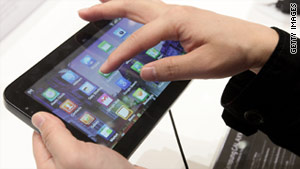
The Android 3.0 tablet: Look, ma, no buttons

Unlike Samsung's Galaxy Tab, pictured above, Google is working directly with Motorola on an upcoming tablet.

San Francisco (CNN) -- Just hours after Google unwrapped the newest version of its smartphone operating system, Android head Andy Rubin gave a peek at the next major release, which will cater to tablets.

At the D: Dive Into Mobile conference kickoff event Monday night, Rubin removed a fabric case from his bag and unzipped it to unveil a black hunk of plastic.

"This isn't due out for a while," Rubin began.

The device, he explained, is a tablet computer that Google is working on with Motorola.

The hardware along with the software it was running bear resemblances to Apple's iPad. Many electronics makers are working on Android tablets with screens that measure 7 inches diagonally. The iPad has a 9.7-inch display, and this mystery device looked to the naked eye about that size.

Notably, the prototype tablet lacks the signature four buttons used to navigate the Android system. This is on purpose, Rubin said.

When turning tablets every which way, the screen shifts its orientation to cater to the user. Fixed buttons on the hardware obviously can't change positions depending on how you hold the unit. Even though the iPad only has one button on its face, "you still get a little lost," Rubin said.

Android's developers have given more thought to simplifying the software, Rubin said. Common tasks should no longer be buried in a sea of menus. Google has also placed a bet on Matias Duarte, the famed designer of Palm's WebOS whom Google hired.

"You'll see the fruits of that investment in the tablet first and then back to the phones," Rubin said of Duarte's work on beautifying Android.

"I would probably characterize Android today as an early-adopter platform," he added. This overhaul would presumably make the system more accessible.

In this inaugural glimpse of Android 3.0, called Honeycomb, Rubin turned on the tablet screen and was greeted with a colorful lock screen. He used his index finger to poke a circular ripple onscreen, and dragged it an inch or so to enter the home screen.

After dodging questions earlier in his fireside chat about integrating video conferencing into Android, Rubin smirked as he fumbled to exit a Google chat application that had video icons sprinkled throughout.
The home screen shows app icons about the size of the buttons on a phone, meaning you can pack more apps and widgets onto the screen.

Rubin then proceeded to show off a new version of Google Maps that can navigate in three dimensions using two-finger gestures. A clockwise turn changes the map's polar orientation. An upward flick shifts the perspective to show the contours of buildings and land.

The new Maps app will be available for Android phones "in a matter of days," Rubin said. An update will join about 130,000 other apps in the Android Marketplace. Certain features will only work on newer handsets.

As for Honeycomb, Rubin provided only a vague timeline of "sometime next year." It will launch first on the Motorola tablet and then on other tablets and smartphones.

The no-button design of this tablet is noteworthy because these types of milestone devices from Google often set the tone for what future Android products will look like.

While Google partnered with Samsung Electronics for the Nexus S smartphone, the Korean hardware manufacturer was on its own for its line of tablets. The Galaxy Tab was based on a version of Android not designed with tablets in mind, so Samsung custom-tailored many apps to work with the 7-inch screen.
A Samsung executive said several months ago that the company would look at integrating Google's official tablet software into Samsung's own stylized version of Android.

Even in this early version of Honeycomb, Android's tablet apps seem more impressively designed than Samsung's. The Gmail app that Rubin showed resembles Apple's Mail program on the iPad or the page you see when navigating to Gmail on an iPad, which itself looks similar to Apple's.

Don't expect Google to slow efforts to mature its smartphone platform any time soon. Despite criticisms about the company giving away Android to manufacturers, the business is healthy, Rubin said.

"We're profitable," Rubin said, acknowledging that mobile ads served to Android users on their own make up for the cost of development. And those efforts are now more focused since Google shuttered its ambitions to be an online seller of phones.

"We bit off a little more than we could chew," he said, referring to the now-discontinued Nexus One phone

Thank : CNN.com

Android 3.0 rumours and latest updates

Now that Android 2.3 features are official, information about its successor, Android 3.0 – Android Honeycomb – is starting to emerge.Here's what we know about Android 3.0 so far.On 20 October, we reported that Android 3.0 tablets are rumoured to be heading out to engineers in time for Christmas. If true, this means that we'll see a whole bunch of tablets running Android 3.0 at CES 2011. It's possible, though, that these tablets could instead be running the recently announced Android 2.3.

Android 3.0 release date
Android 3.0 release date is looking like early 2011.

UPDATE: In a video on All Things Digital posted on 7 December Google's Andy Rubin showed off a prototype Motorola Android 3.0 tablet and confirmed that the Android 3.0 release date will be "some time next year".


Android 3.0 features and specifications
As we reported earlier in July, a Russian podcast details how Android 3.0 will be restricted to high-end handsets (and tablets). The podcast explained that Android 3.0 phones will require at least a 1GHz processor, 512MB of RAM and 3.5-inch or larger displays.
The feature list for Honeycomb is currently scant, but will include elements that didn't make it into Android 2.3.
Android 3.0 phones
One of the first Android 3.0 phones could be the Samsung Galaxy S2 if another rumour is to be believed. The leaked details of the Galaxy S I9200 claim a 4.3-inch screen with a resolution of 1280x720.
On 27 October 2010, reports appeared that Google was planning to release an Android 3.0 powered Nexus Two with Carphone Warehouse, although we now know that the next Nexus - called the Nexus S and available through Carphone Warehouse and Best Buy - is running Android 2.3
It's also possible that the PSP Phone will be running Android 3.0
Android 3.0 tablets
Acer has announced 7- and 10-inch Android tablets which are slated for release in April 2011. This means they'll almost certainly be running Android 3.0.
The prototype Android 3.0 Motorola tablet that Andy Rubin showed off is running on what Rubin described as Nvidia's "dual core 3D processor" - presumably this is a Tegra chip.